
 Renke Holert
7 min read
Import Excel file into Planner Premium
For project managers who have been managing their projects with Microsoft Excel, Microsoft now offers a very simple...
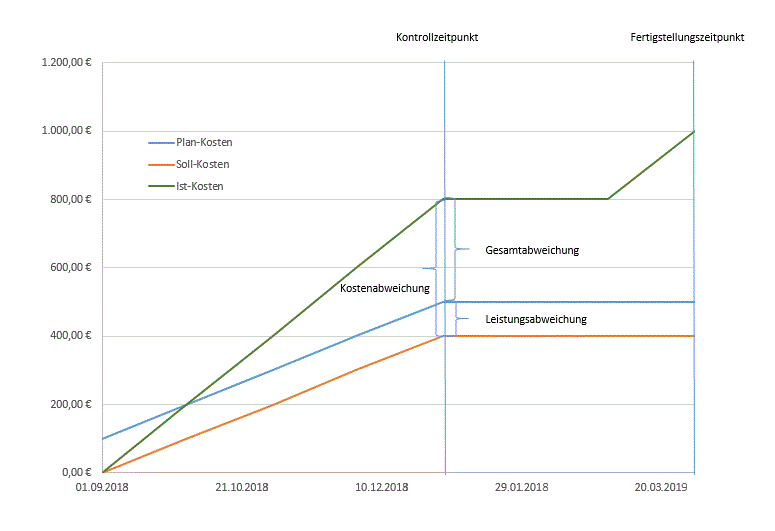
I frequently come across similar terms — particularly in German — used to describe the status of a project with regard to cost and schedule. Here is a proposal for consistent terminology, drawn as far as possible from the PMI's PMBOK Guide (especially from the area of earned value analysis). To my knowledge, there is no clearly defined term specifically for the expected completion date. The German terms for actual, earned, and planned cost may also be written with a hyphen: Ist-Kosten, Soll-Kosten, and Plan-Kosten instead of Istkosten, Sollkosten, and Plankosten. The control date corresponds to the status date, which is usually the current date.
Key takeaways
Suggestions for improvement, comments, and references to official sources such as PMI, DIN, or ISO — or to the terminology used in standard software from Microsoft, SAP, or Atlassian — are welcome.
| German | English | Abbreviation | Explanation |
|---|---|---|---|
| Istkosten | Actual Cost | AC or ACWP | Actual costs incurred as of the control date |
| Sollkosten | Earned Value | EV or BCWP | Planned cost of the work actually performed as of the control date |
| Plankosten | Planned Value | PV or BCWS | Planned costs as of the control date |
| Leistungsabweichung | Schedule Variance | SV | Value of the delayed work at planned rates as of the control date |
| Kostenabweichung | Cost Variance | CV | Difference between the actual cost and the planned cost of the work performed as of the control date |
| Geschätzte Restkosten | Estimate to Completion | ETC | Expected remaining costs until completion |
| Geschätzte Gesamtkosten | Estimate at Completion | EAC | Expected total costs at completion |
| Geschätzter Fertigstellungstermin | Estimated Completion Date | ECD | Expected completion date |
What does the control date mean in earned value analysis?
The control date (data date) is the cut-off date as of which actual, earned, and planned cost are measured — in practice, usually the current date of the status report.
What is the difference between EV and BCWP?
None in substance: EV (Earned Value) is the term PMI uses today, while BCWP (Budgeted Cost of Work Performed) is the older abbreviation from earlier PMBOK editions that is still used in places. The same applies to PV and BCWS.
How do you calculate cost variance (CV)?
CV = EV − AC, the difference between the value of the work actually performed (earned value) and the actual cost incurred for it as of the control date.
Where do these terms come from?
They come from earned value analysis in the PMI's PMBOK Guide and are used in similar form in standard software such as Microsoft Project, SAP, and Jira.
The terms in the table are quickly defined within a single project file — in practice, earned value analysis fails when AC, EV, and PV have to be pulled together manually from multiple projects, tools, and cost centers and recalculated for every status report. Without consistent reporting, the control date stays a snapshot rather than a reliable trend.
This is exactly where our PPM software selection and implementation consulting comes in: for more than 25 years, we have connected project and portfolio data from Microsoft Project, Planner, and Jira with Altus PPM and Projectum xPM into automated, up-to-date earned value reporting across all projects — delivered for clients including Rohde & Schwarz, KUKA, and LAPP. Learn more about our approach at PPM Software Selection: Fixed-Price Consulting, and see real-world examples in our PMO and project management references.
If too much time passes between the current date and the status date in your organization, get to know our modern PPM solution, which lets you create status reports that are up to date as of today and jump back in time within your status reports as far as you like to identify trends and make forecasts. Learn more at our PMO/VMO events.
7 min read
Aug 9, 2026 Renke Holert
For project managers who have been managing their projects with Microsoft Excel, Microsoft now offers a very simple...
2 min read
Jun 9, 2026 Renke Holert
About Siemens Siemens Mobility, a division of Siemens AG, is a pioneering global player in the realm of transportation...
2 min read
Jun 9, 2026 Renke Holert
Challenges with Microsoft Project At adidas all product development tasks are centrally planned with Microsoft Project...